

Skip links

Zero-Touch Onboarding in Industrial IoT: Why manual device onboarding no longer scales

Zero-Touch Onboarding in Industrial IoT: Why manual device onboarding no longer scales

Zero-Touch Onboarding in Industrial IoT: Why manual Device onboarding no longer scales

A production site is bringing 500 new sensors online. Every device needs to be identified, authenticated, configured, and integrated into the existing infrastructure. Done manually, that means technicians setting up each device individually on-site. Multiple teams need to coordinate, and experienced specialists are required at every location.
What works fine with a handful of devices quickly becomes a serious operational challenge as device fleets grow. The bottleneck isn't connectivity itself. It's the question of how to integrate new devices into existing systems quickly and reliably. At the same time, the number of connected devices keeps growing while qualified specialists are increasingly hard to find. Manual processes simply don't scale under these conditions.
The central question is:
How can new devices be integrated into existing infrastructure without technicians having to set up each one by hand?
That's exactly the problem Zero-Touch Onboarding solves.

What Is Zero-Touch Onboarding?

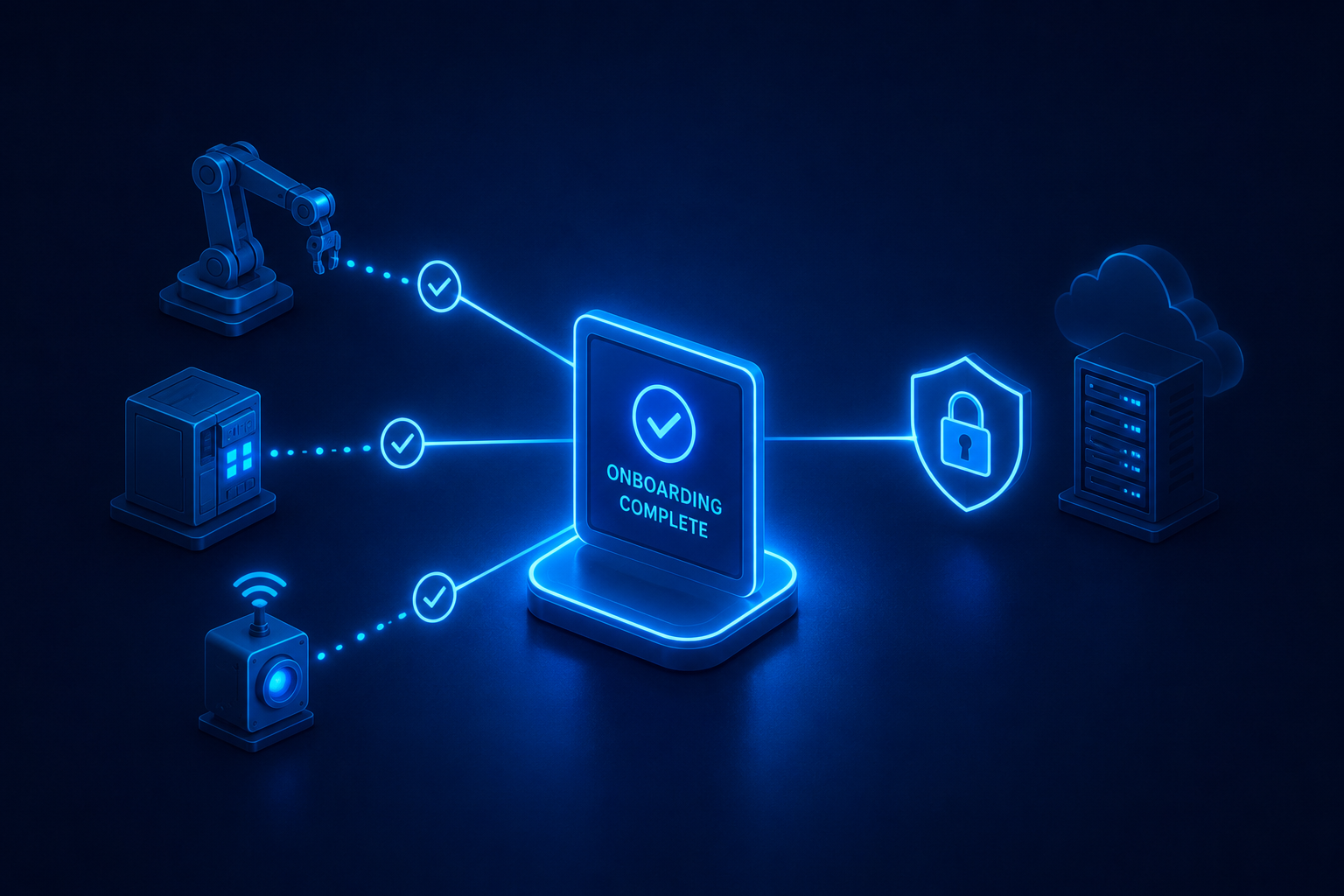
Zero-Touch Onboarding is an approach that allows new devices to be onboarded largely automatically. As soon as a device connects to the network for the first time, the onboarding process starts on its own. In most cases, no manual intervention from a technician is required.
What the process looks like in detail depends on the architecture and platforms in use. In most environments, the system registers the device, verifies its identity, provisions the required certificates and security policies, and integrates it into the existing infrastructure.

Zero-Touch Onboarding and Provisioning — What's the difference?

Provisioning and Zero-Touch Onboarding are often mentioned together and sometimes used interchangeably. In reality, they describe two distinct steps.

Provisioning prepares a device technically for deployment. This includes installing software, loading configurations and certificates, and applying basic system settings.

Zero-Touch Onboarding goes a step further. It doesn't just prepare a device technically. It also automatically integrates it into the existing infrastructure. The system verifies the device's identity, assigns it to the right operator or project, and ensures it can be put to productive use immediately.

Provisioning prepares a device. Zero-Touch Onboarding makes it part of the existing infrastructure.

What Zero-Touch Onboarding require?

Zero-Touch Onboarding only works reliably when several technical components work together seamlessly. Each one handles a specific task. From establishing a unique device identity to applying the final configuration.

Device identity

Every device needs a unique, cryptographically secured identity. Without it, the system has no way to reliably recognize the device when it first powers on and trigger the onboarding process.

Trusted communication

Using a Public Key Infrastructure (PKI), the device proves its identity. Only once this verification is successful does it receive the required certificates and gain the ability to communicate securely with other systems.

Automatic assignment

Once the identity has been confirmed, the system automatically assigns the device to the right infrastructure and the appropriate operator. This means manufacturers can produce and ship devices without knowing their final deployment location at the time of manufacturing.

Automatic configuration

After assignment, the device automatically receives all required configurations and policies. In many architectures, a Device Management Platform handles this step as soon as the device has been registered and assigned to the correct operator.

What challenges manual device onboarding create?

The real challenges don't end with the initial installation. Many problems only surface during ongoing operations: When a device fails, an audit comes up, or a security incident needs to be investigated. The larger the device fleet, the more pronounced these weaknesses become.
Delayed rollouts
When devices are onboarded manually, companies depend on experienced on-site technicians. Many tasks can only be carried out sequentially or for a limited number of devices at a time. This delays production starts, extends project timelines, and drives up travel and personnel costs.
The problem becomes particularly visible with larger rollouts. When multiple sites need to be equipped simultaneously, coordination demands rise sharply. Every day a plant is ready to operate but not yet producing adds to the cost. For companies looking to grow quickly or open new locations, manual device onboarding quickly becomes a structural bottleneck.
Higher error rates
Manual processes are error-prone. Even when everyone involved is working carefully, different approaches lead to inconsistencies. At the same time, no system automatically checks whether all settings have been applied correctly and completely.
The consequences often only emerge later. Individual devices need to be reconfigured, projects get delayed, or plants experience unplanned downtime. Every correction costs time and money. Costs that can largely be avoided with standardized, automated processes.
Lack of transparency and traceability
When devices are set up manually, many systems don't automatically document changes. That makes it difficult to determine later who changed a configuration, when the change was made, or what the original settings were.
With each additional plant and every new device, maintaining oversight becomes harder. This complicates troubleshooting, extends downtime, and makes audits significantly more demanding. Without complete documentation, teams often have to reconstruct changes by hand, tying up personnel and consuming valuable time.

What Zero-Touch Onboarding change in operations?

Zero-Touch Onboarding doesn't just automate individual tasks. It changes the entire process by which new devices are brought into an existing infrastructure. The impact is most significant when companies are rolling out large numbers of devices or continuously expanding their infrastructure.
Effort no longer grows with device count
Whether ten or a thousand devices are being onboarded, the process stays the same. Rollouts that previously took weeks and required experienced technicians across multiple sites can now be completed much faster.
That saves more than just time. Companies can scale their infrastructure without having to scale their team at the same rate. As the number of devices grows, the associated effort increases far more slowly than it would with manual onboarding.
Every device Is configured the same way
Each new device automatically receives the same configurations and security policies. Variation between technicians no longer plays a role.
This reduces misconfiguration rates and ensures that new devices are set up to the same standard from day one. Problems that previously only surfaced during live operation can be avoided entirely.
Compliance becomes easier
All configurations are centrally managed. Changes are automatically documented and stored in a traceable way.
Information that previously had to be pieced together manually is available at any time. This simplifies audits and helps companies demonstrate compliance with requirements from NIS2, the Cyber Resilience Act, or IEC 62443, without additional manual effort.

Zero-Touch Onboarding in practice

A machine builder ships several thousand edge devices to customer sites around the world every year. Without a standardized onboarding process, every device would need to be assigned to a project, individually prepared, or set up on-site at a later point. With each new shipment, the workload grows and quickly becomes an organizational bottleneck.
With Zero-Touch Onboarding, manufacturers can produce, warehouse, and ship devices without pre-assigning them to a specific customer. The first time each device powers on, it automatically receives the right configuration. Operators get new devices up and running much faster and no longer need to manage rollouts as heavily.
This approach isn't limited to mechanical engineering. In manufacturing, energy supply, logistics, and process industries, new devices are continuously being added or deployed across many distributed sites. Zero-Touch Onboarding ensures that new devices can be integrated into existing infrastructure quickly and reliably, keeping operations manageable even as device fleets grow.

Conclusion

With every new machine, sensor, and gateway, the effort required to onboard devices securely and reliably increases. The real challenge isn't any individual device. It's repeating the same process over and over for an ever-growing fleet.
That's exactly where Zero-Touch Onboarding comes in. Instead of setting up each device individually, it automates the entire onboarding process, from identity verification and configuration to integration into the existing infrastructure. Companies onboard new devices faster, avoid errors, and maintain oversight even as their fleets scale.
Zero-Touch Onboarding becomes an important foundation for scalable Industrial IoT infrastructure. The more companies connect their operations, the more critical a standardized, automated onboarding process becomes.
WordPress Cookie Notice by Real Cookie Banner